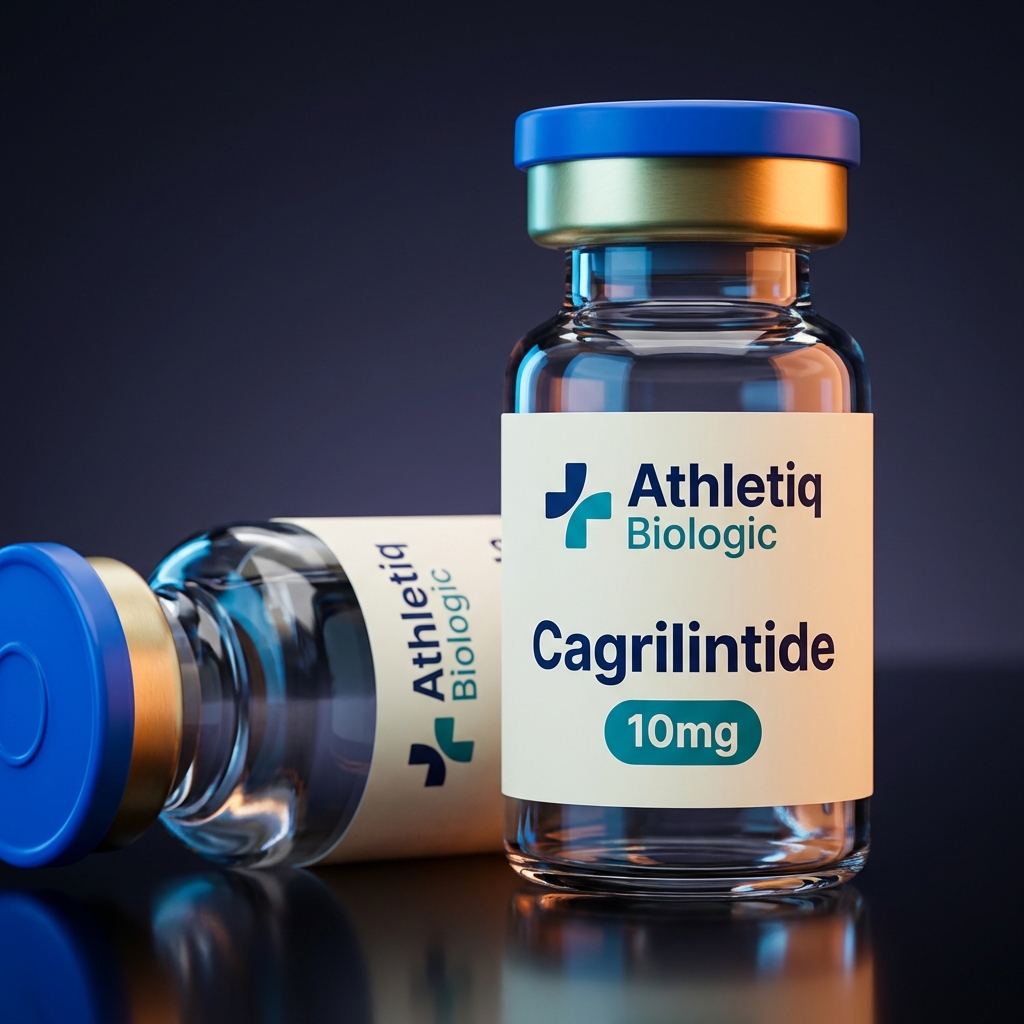
Description
Cagrilintide (Long-Acting Amylin Analog)
Batch Specific COA Download | COA Results Pending
Cagrilintide is a long-acting, fatty acid-conjugated analog of the endogenous pancreatic hormone amylin, engineered specifically for sustained receptor engagement in metabolic research. Specifically, it targets the amylin receptor subtypes (AMY1, AMY2, AMY3) — which are distinct from the GLP-1 and GIP receptor systems — providing investigators with an independent, non-incretin axis of appetite and metabolic research. Therefore, it operates through the hindbrain and hypothalamic circuits that native amylin engages, but with dramatically extended half-life compared to the native hormone, which degrades rapidly in vivo. We offer this high-purity compound for investigators who want to characterize the amylin pathway in isolation, without the confounding effects of GLP-1 or GIP co-stimulation. Currently, Cagrilintide is the most advanced long-acting amylin analog available for research, having demonstrated significant standalone efficacy in obesity models before being studied in combination protocols. So, labs use it to build a clean pharmacological baseline for the amylin axis, establishing what the pathway delivers independently before introducing co-agonists. Thus, it remains the definitive single-pathway tool for amylin receptor research.
How It Works
Cagrilintide functions as a “central satiety signal” that speaks to the brain directly, bypassing the peripheral metabolic pathways that define incretin-based research. First, it binds the amylin receptors in the area postrema — a brain region outside the blood-brain barrier that acts as a chemical sensor for circulating hormones — and the hypothalamus. This creates a centrally mediated suppression of appetite that is neurologically distinct from the hypothalamic GLP-1 receptor signaling. This means the research model receives a satiety signal from a different anatomical and hormonal source than what incretin agonists engage. Then, it works in parallel on gastric motility: like amylin, Cagrilintide slows gastric emptying through its own receptor mechanism, reducing the rate of nutrient delivery to the small intestine and prolonging post-meal satiety. Unlike GLP-1, however, this gastric effect appears to be governed by different neural pathways, which is why the two compounds can be stacked without apparent signal competition. Consequently, the research model experiences a reduction in meal size, a reduction in meal frequency drive, and an altered perception of food reward — a behavioral shift that distinguishes amylin-mediated satiety from pure incretin-mediated satiety. As a result, body composition studies in research models treated with Cagrilintide alone show meaningful reductions in adipose mass, establishing it as a standalone contributor before any combination protocols are introduced. Furthermore, because the amylin receptor also has activity in the regulation of bone turnover and glucagon release, researchers use Cagrilintide to probe these secondary axes in isolation — areas that incretin research cannot access.
Lab Uses
Labs use Cagrilintide as a standalone when the research objective requires clean characterization of the amylin receptor axis without incretin co-stimulation. This is essential for properly attributing outcomes when Cagrilintide is later introduced in a combination protocol — the baseline must be established first. Additionally, investigators use it to study central appetite behavior, particularly the amylin system’s role in modulating the hedonic value of food, a mechanism linked to dopaminergic reward pathways in the CNS. It is also used in bone density and remodeling studies, as the amylin receptor’s activity in osteoblast regulation is an area of active investigation independent of its metabolic effects. Research programs studying glucagon suppression as a standalone mechanism — separate from the GLP-1-mediated glucagon effect — also rely on Cagrilintide for its direct amylin-receptor-mediated action on alpha cells.
Synergistic Pairing: GLP-1 S for the Complete CagriSema Protocol
For labs ready to move beyond standalone amylin characterization, Cagrilintide pairs directly with GLP-1 S Peptide to replicate the CagriSema dual-pathway protocol. This combination is available pre-blended in a single vial as the Cagrilintide / GLP-1 S Blend, or investigators can obtain each compound separately for flexible dosing studies. Running both a standalone Cagrilintide arm and a GLP-1 S arm alongside the combined protocol is the most rigorous way to quantify the precise additive contribution of each pathway to the observed outcomes.
Technical Specs
We ship this as a specialized lyophilized powder to ensure maximum peptide stability during transit.
Name: Cagrilintide
Receptor Targets: Amylin Receptors (AMY1, AMY2, AMY3)
Purity: ≥99% (HPLC Verified)
Format: Lyophilized Powder
Storage: Freeze at -20°C for long-term stability.
Reference Data
Pubmed: Cagrilintide (AM833) — A novel long-acting amylin analogue for obesity treatment
Research Use Only Warning
We sell this strictly for lab research. No Human Use: Do not use this Cagrilintide as a weight loss drug or medication. No Injections: It is not for personal medical use or human administration. Expert Use: Only trained staff and qualified investigators should handle this compound.

Reviews
There are no reviews yet.